



The Myth of the Waffle Iron
I pulled the early 1960s workbench logs from the Hayward Field archives, expecting to find the origins of the benevolent, mythological inventor that corporate history has sold us for decades. The official narrative portrays Bill Bowerman as a fatherly track coach, struck by sudden inspiration over his wife’s waffle iron, pouring rubber to gently cushion the feet of his beloved Oregon runners. It is a clean, sanitized story of American ingenuity.
But flipping through the raw, grease-stained notes of his actual process, that folksy mythology immediately dissolves.
The records reveal a gritty, almost forensic obsession. Bowerman did not invent Nike’s first massive bestseller, the Cortez, from a blank canvas. He did not experience a pristine "eureka" moment. Instead, he operated like a ruthless, unsentimental pathologist. To understand the genesis of the modern running shoe, you have to realize that Bowerman viewed the existing footwear market not as a standard to beat, but as a collection of flawed biological specimens waiting to be dissected.
The Specimens on the Table
By the mid-1960s, competitive distance running was brutal on the human anatomy. The standard athletic shoes of the era were essentially leather slippers with a thin slab of rubber slapped on the bottom. They offered zero shock absorption, and Bowerman was watching his elite athletes constantly break down with stress fractures and shattered Achilles tendons.
He didn't have the manufacturing capability to build a completely new shoe from scratch, but he had access to the top-tier racing flats of the era: the German Pumas and the Japanese Onitsuka Tigers.
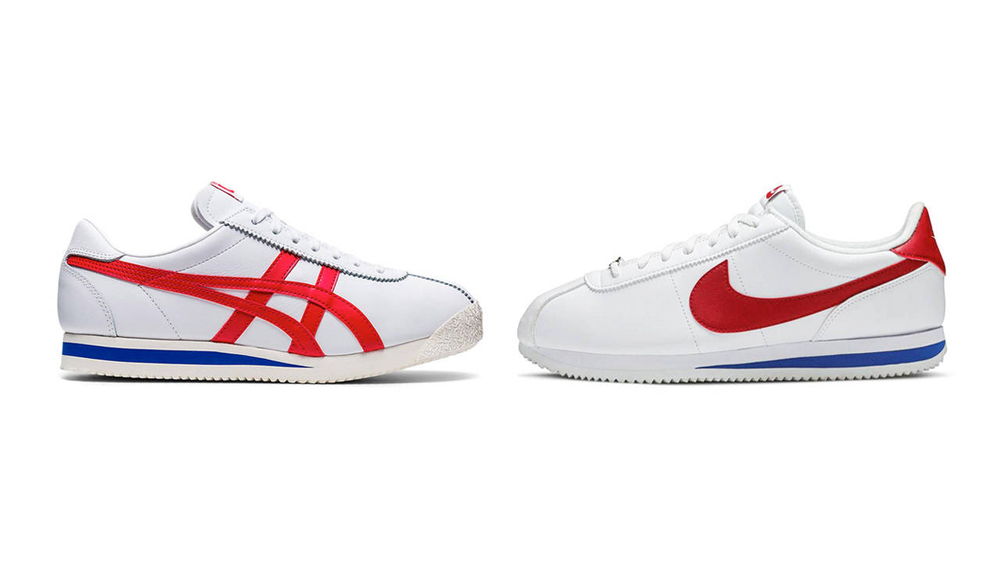
To Bowerman, these foreign shoes were not sacred products; they were raw material. Reading the accounts of his former athletes, his workshop was less like a design studio and more like a surgical theater. He would order batches of expensive, imported competitor shoes, completely ignoring their intended use. The moment they arrived, they went straight onto his workbench to be eviscerated.
The Dissection
Bowerman attacked the competitor shoes with scalpels, tin snips, and pliers. He wasn't casually studying their design lines; he was performing a biomechanical autopsy.
He would literally carve them open to expose their structural failures. He ripped the leather uppers away from the soles to examine how the glue held up under torque. He sliced the rubber outsoles down the middle to measure the exact millimeter where the cushioning failed to protect the metatarsals. He was looking for the precise mechanical reasons why a runner's foot was bleeding or cramping after five miles.
If a German shoe had a terrible heel counter but a fantastic toe box, Bowerman noted it. If a Japanese shoe had excellent lightweight nylon but a completely useless arch support, he documented the failure. He was breaking down the industry standard into its most basic anatomical parts, discarding the useless tissue and isolating the functional organs.
The Surgical Graft
Once he had a pile of eviscerated competitor shoes, the actual "design" process began. It was a messy, brutal act of physical grafting.
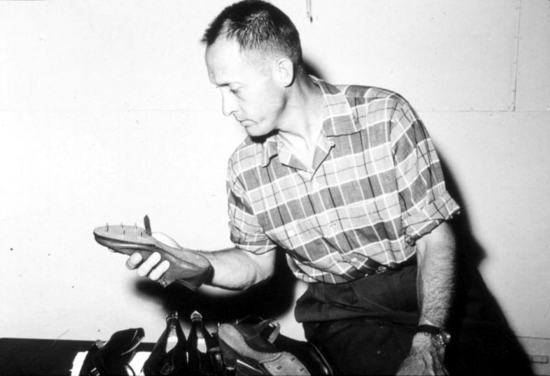
Bowerman took the surviving, functional components of these dissected shoes and Frankenstein-stitched them together. He would take the lightweight upper of an Onitsuka Tiger and physically glue it to a modified heel he had carved out of a different shoe. When he realized that none of the existing models had adequate cushioning for the grueling American road races, he abandoned traditional shoe materials entirely. He went to local pharmacies and hardware stores, bought slabs of industrial shower sponge and flip-flop rubber, hacked them into wedges with a bread knife, and shoved them directly into the eviscerated cavities of the Japanese track shoes.
These early prototypes were monstrous. They were ugly, glue-stained, mismatched abominations that looked like they had barely survived a factory explosion.
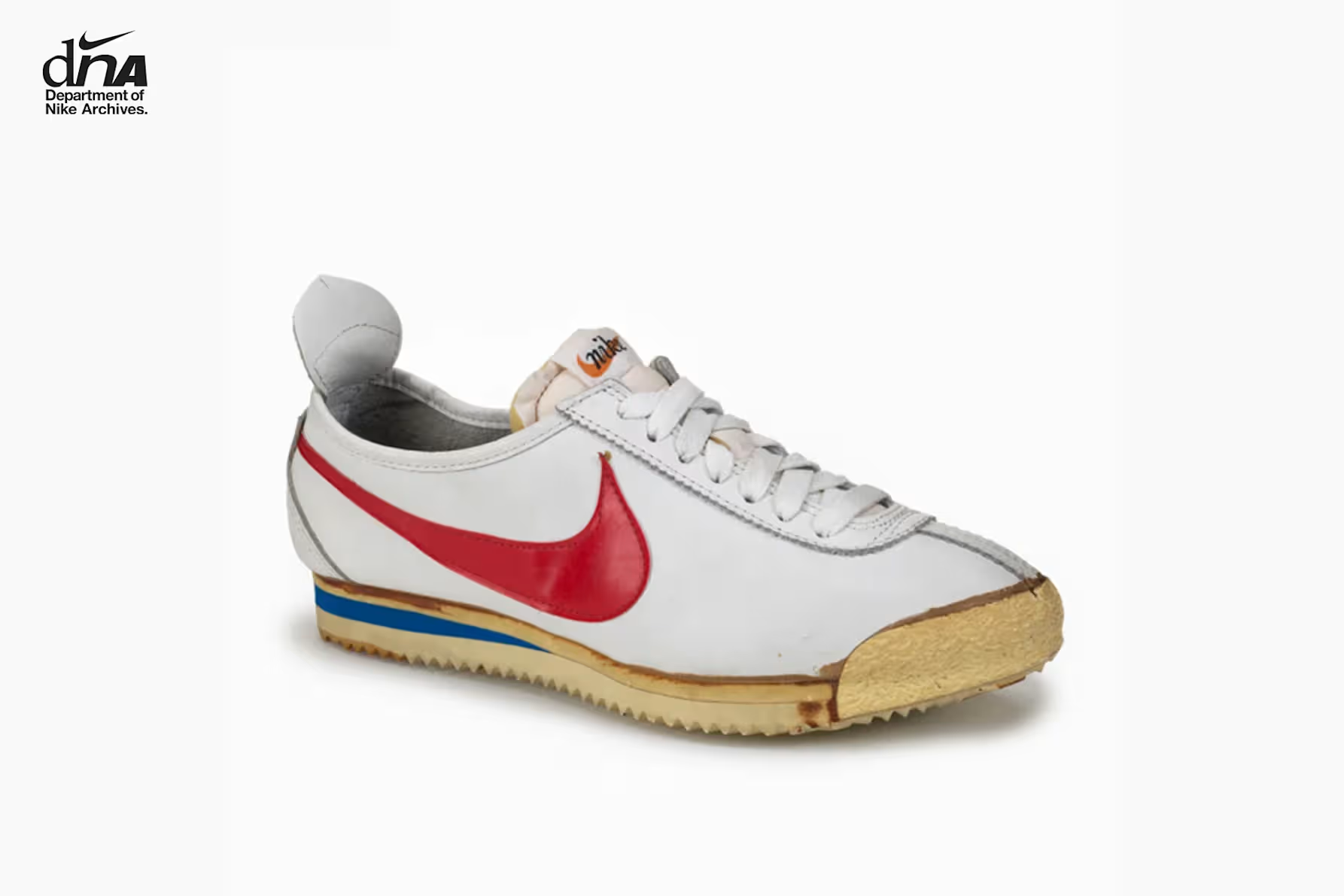
But they worked.
The Anatomy of the Cortez
The athletes who tested these stitched-together monsters didn't care about the aesthetic horrors of Bowerman's workbench. They cared that their shins had stopped splintering.
By taking the best ligaments of the German shoes, the skin of the Japanese shoes, and injecting it with his own crude, industrial sponge-rubber grafts, Bowerman had accidentally engineered a completely new biomechanical beast. He had created the first true dual-density foam midsole, an innovation that would forever alter human locomotion.
This brutal, patchwork monster eventually became the blueprint for the Cortez.
I closed the workbench logs. We are conditioned to believe that technological leaps require pristine laboratories, massive research budgets, and highly original design philosophies. But the true, gritty origin of the sportswear empire proves otherwise. The foundation of Nike was not built on polite innovation. It was built on violent, calculated cannibalism, proving that in a ruthless market, sometimes the most effective way to build the future is to physically carve it out of the rotting corpse of your competition. ~
BrandAnatomy operates independently. You can anonymously fund future forensic deep-dives.
Sources
- Knight, P. (2016). Shoe Dog: A Memoir by the Creator of Nike. Simon &
- Schuster.Moore, K. (2006). Bowerman and the Men of Oregon. Rodale Books.